Each and every ancient civilization had their own history which were
not recorded in those days. With the passage of time, evidences has been
uncovered now and again through archeological studies. Archeology is the
main method available for learning about the history of such civilizations.
It can unveil a rich store of information about the beliefs, social structure,
economic organization and environmental effects of past societies. The
word archeology is derived from two Greek words 'archaios' which means
ancient things and 'logos' which means theory of science. Archaeology
was first put to use by the Romans in the eighteenth century but it was
given more accuracy by Heinrich Schliemann who brought to light the origins
of Greek civilization.
Archaeology is a rewarding and challenging career opportunity for those
who have an analytical bend of mind and a keen desire to know about the
past. It can give awareness about the heritage and tradition of a country
or a culture. It is the scientific and systematic study of past and human
cultures through the recovery, analysis and documentation of material
remains and environmental data, like architecture, artifacts, features,
landscapes and biofacts. It is the field of conservation and protection
of architectural relics, old monuments, inscriptions etc. In fact,
Archaeology is the science that helps to build up a picture of the past.
In India, the importance of preserving the rich and cultural heritage
was initiated by General Alexander Cunningham. It was he who established
the Archaeological Survey of India in 1862 for the maintenance, conservation
and preservation of centrally protected monuments and archaeological sites
in the country. Due to his contribution in Indian history and Archaeology,
Cunningham is considered as the father of Indian history and Archaeology.
Archaeology is a multidisciplinary science which draws help from geography,
history, anthropology, chemistry, geology, art and literature. It is also
regarded as one of the four branches of Anthropology, which is the study
of the physical and social characteristics of humanity. The cultural and
social events of the past have been relived through archeological studies.
Archaeological studies or inputs are considered important in issues such
as environmental conservation, urban societies, town planning etc. These
discoveries involve a variety of field techniques and laboratory procedures.
Those who are involved with the studies of archaeological discoveries
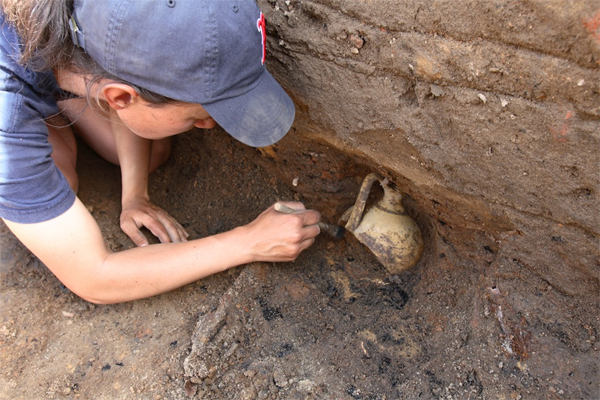
is termed as Archaeologists. The main activities of an Archaeologist include
preliminary fieldwork, excavation of sites and periodical classification
of them as well as dating and interpretation of materials so excavated.
They probe into the past and define earlier civilizations. Their researches
and findings are preserved and maintained for present and future learning. Modern
archaeologists have enhanced the accuracy of their work with scientific
techniques of carbon dating of artifacts and the use of DNA analysis.