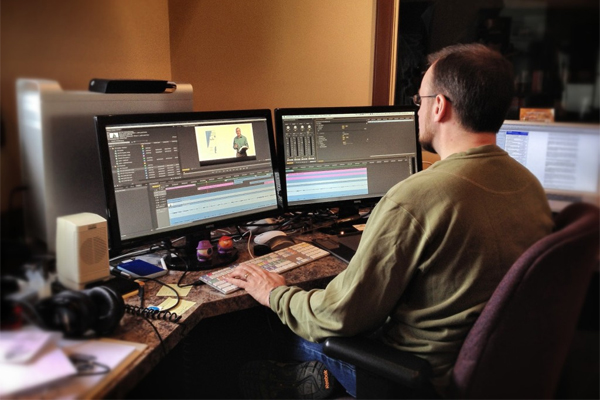
Video Editing, is an interesting career for creative people in the media
and entertainment industry. The entire process of making art, aesthetic
in the visual media, lies in the technique of editing. Video editing is
the process of re-arranging or modifying segments of video from one or
more video tapes to form a refined and final piece of video. Video editing
plays a key role in the post production process. The main task of the
video editor is to edit soundtracks, film and video for the motion picture,
cable and broadcast visual media industries. It is the video editors skill
that determines the quality and delivery of the final product.
Video Editing is classified as Linear Editing (Tape to tape), and Non-linear
editing or Digital Video Editing. Digital video editing uses computer
technology to enable the editing process onscreen. Linear editing involves
copying just the required portions of a film from one tape to another.
Any changes or additions needed could be made only by copying the edited
content onto another tape, causing undesirable degradation of images.
In Non- linear editing, video and audio data are first captured to hard
disks or any other digital storage device and then edited on the computer
using any of the wide range of software's available for editing. Here
data can be edited and subsequent changes made without duplicating the
actual film data. It is quicker, less expensive, more flexible and saves
time and money when compared to the traditional way of editing. Due to
all these features and the introduction of new technologies in digital
video editing, it is fast replacing the traditional or linear editing.
Video editors are in great demand with the advent of streaming videos
and movie clips in websites. As this field is becoming highly competitive,
video editors can expect keen competition for job openings. The increased
popularity of online video clips has also produced a large increase in
video editing activity by internet users.